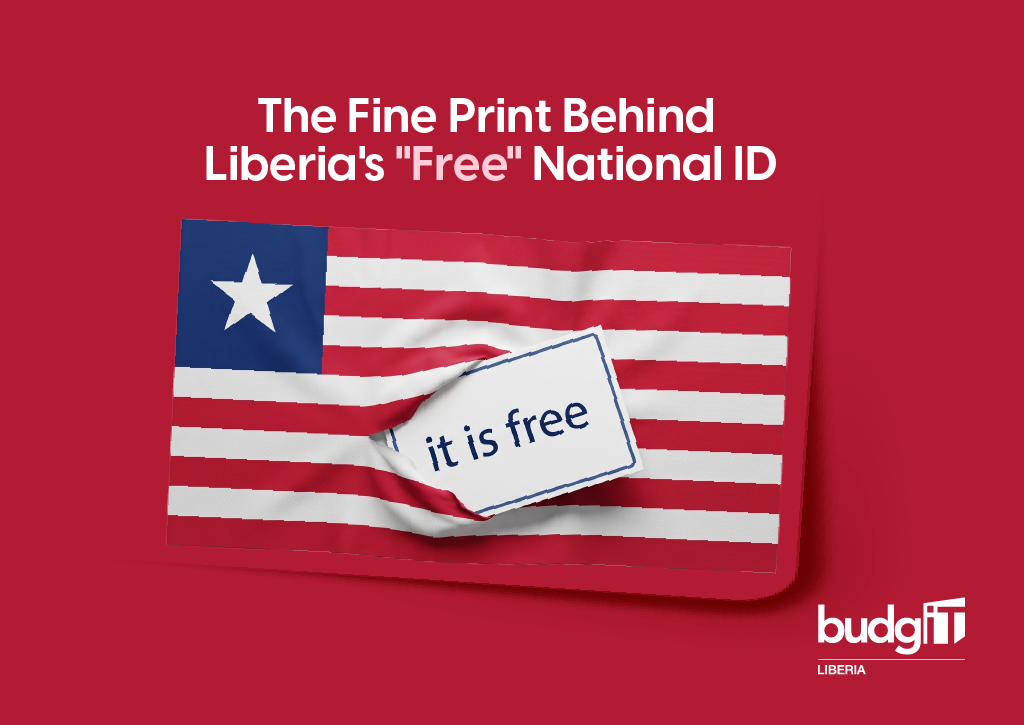
There is a quiet catch buried in one of the most hopeful sentences Liberians have heard from their government in years. The national ID card, officials keep saying, will be free. And for millions of people who have spent the last few years locked out of banks, clinics, and government offices for want of a piece of plastic, that word lands like a promise. But anyone who has watched a government project unfold in real time knows to ask the obvious follow-up. Free for whom, exactly, and paid for by whom?
The answer turns out to be more honest and more complicated than the headline suggests.
Start with what “free” actually means here. The National Identification Registry has been charging five US dollars for a card. It sounds trivial until you remember that more than half of Liberia’s population lives below the poverty line and that a document now demanded for opening a bank account or receiving public services has effectively become a tax on the poor. Lawmakers noticed. When the issuance ground to a halt last year amid broken equipment, endless queues, and open talk of bribery at enrollment centers, members of parliament pushed hard for the fee to disappear altogether. The government eventually agreed, but with a line drawn carefully through the middle. In mid-September, NIR Executive Director Andrew Peters clarified that free cards will go specifically to disadvantaged and unemployed Liberians, an estimated 3.5 million vulnerable citizens who genuinely cannot pay. Everyone else, employed Liberians and foreign residents alike, will still be charged. So the “free national ID” is really a targeted subsidy for people at the bottom, not a gift to the whole country. That is a defensible policy. It is just not the same thing as the slogan.
Which brings us to the money and to an Austrian printing house most Liberians have never heard of. Rather than run a conventional government tender, President Joseph Boakai chose a public-private partnership structured as a Build, Operate, and Transfer concession with the Austrian State Printing House, known as OSD. The mechanics are worth understanding because they explain everything about who ultimately pays. OSD puts up the money first. It finances the nationwide enrollment drive, installs the ICT infrastructure, and produces the secure polycarbonate cards. In exchange, it recovers that investment over time before handing the entire system back to the Liberian state. The figure attached to all of this has climbed to roughly 54.7 million dollars, notably higher than the 39 million reported in some earlier coverage.
Peters has been at pains to insist this is a financing arrangement, not a surrender of control. OSD’s job, he says, is to invest in the plumbing. The registry itself conducts the registration and keeps custody of citizens’ personal data, and it remains, in his words, a government institution responsible for identity registration and data governance. That distinction matters enormously to a public that has grown wary of foreign firms holding the keys to its citizens’ most sensitive information.
But peel the concession apart and the question of who pays resolves into layers rather than a single answer. In the immediate term, OSD pays, carrying the upfront cost of getting millions of people enrolled. Over the medium term, paying customers pay, because the fees collected from employed citizens and foreign residents are precisely what allow OSD to earn its investment back. And in the end, the government pays, both by covering the cost of the free cards handed to eligible citizens and by eventually assuming ownership of the whole system. A concession is not charity. Every dollar OSD advances has to come back to it somehow, whether through user fees, government payments, or both. The free card slipped into the hands of an unemployed Liberian in some rural county is real, but it rests on a chain of financing that runs straight through the people who do pay and the national treasury behind them. Spreading a cost over time is smart. It does not make the cost vanish.
If it works, the payoff is bigger than the card itself. The plan would link the national ID to Liberia’s civil registration system, weaving identity together with records of births and deaths and building toward a genuine digital infrastructure for verifying who people are across both government and private services. The ambition is to enroll the entire population within about eighteen months, a striking goal in a country where barely fifteen percent are currently covered. Officials have promised cybersecurity safeguards, audit trails, and technology transfer so Liberia is not chained to a foreign vendor forever, and Peters has warned citizens not to hand money to middlemen promising to jump the line.
For now, though, none of it is settled. The agreement still sits before the National Legislature, and until lawmakers ratify it, the enrollment schedules and locations stay frozen. The promise of a free ID is genuine, and for the people it targets it could be transformative. It simply arrives with an invoice attached, addressed to someone else, and whether that arrangement holds up will depend on the scrutiny it gets before anyone signs.